- Olena
- Viktor
- Rimma and Tamara
- Evacuation brings new struggles
- Supporting people through evacuation and beyond
Stories of evacuation from the frontlines of Ukraine.
By Joachim GiaminardiPublished 12. Nov 2025
An evacuation can change your life forever. Evacuations are always a loss, from which recovery can be incredibly challenging. It’s no surprise that people are willing to postpone the decision to leave their home, even as danger comes incredibly close.
Civilians living along Ukraine’s frontlines continue to face insecurity and violence as the conflict escalates in 2025. Increasing drone and missile attacks are resulting in more and more civilian casualties. People living in areas under constant threat are faced with an impossible decision: stay in their homes, or evacuate towards an uncertain future?
An evacuation means leaving your home, maybe forever. But when is the right moment to do it? Is it when the frontline is a few kilometres from your village? What if the mobile phone networks go down? What if you see a tank firing a few hundred metres away from you, on your street? What if you do not know how to get out safely, or what will happen after you have been evacuated? What if you cannot afford to leave? What if…
People face many unknowns when making these life-changing decisions. Across Ukraine, the Norwegian Refugee Council (NRC) is working with its partners to ensure that civilians are well informed and fully supported before, during and after being evacuated.
These are some of the stories of the people we work with:
Olena
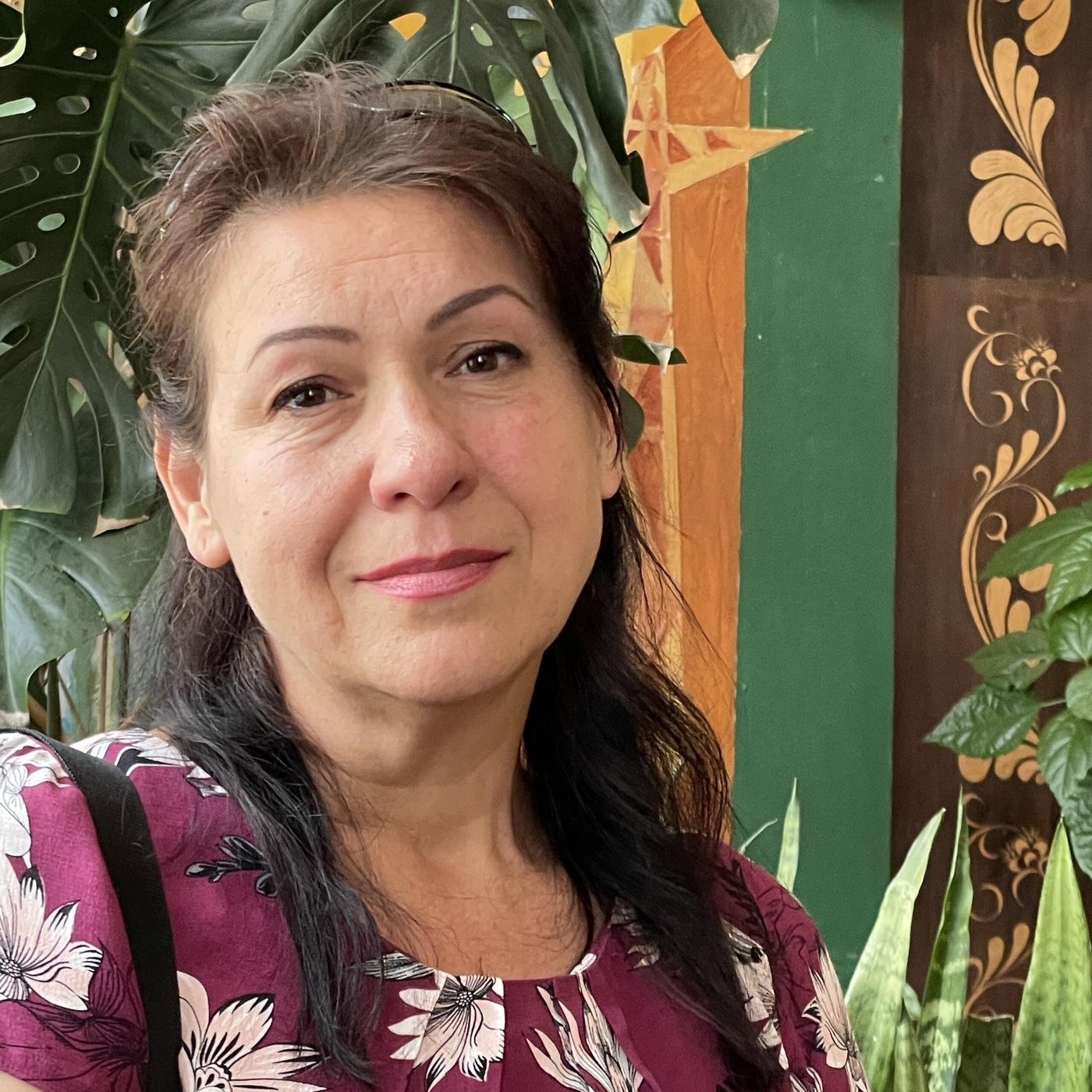
Olena, a 53-year-old kindergarten teacher, lived in the village of Studenok, in northern Ukraine, close to the Russian border. When the hostilities intensified there in early 2025, she was living with her brother.
“The local market and most of the infrastructure in the village were damaged or destroyed by that point,” she recalls. “One person was coming to distribute food, but they stopped when the attacks increased.”
“It became incredibly dangerous to leave the house because of the drones and the violence. One day, I looked out of the window and saw a Russian tank firing from a few hundred metres away.
There were drones flying everywhere in the village
Olena
Even as the fighting approached, Olena remained in her home. “We still had a mobile connection, so I could talk to my family and children,” she reflects. “When the connection stopped working, I knew it was time to leave.”
Then in April, her brother was fatally wounded and died.
“The day we finally evacuated, there were drones flying everywhere in the village. I was escorted by soldiers while explosions went off all around us. I remember that some soldiers and civilians were killed that day. Only after I left was the body of my brother delivered to me.”
With just a couple of minutes to leave her home, Olena was only able to pack a small number of things. She took her insulin, a family photo album, and her personal documents.
Viktor
When Viktor is asked what he took with him, he points to his hat. The fighting had come so close that his only option was to walk out of his house.
Viktor is elderly and had been living in a border settlement in the Sumy region. He was living alone as his wife had already left, and both of his sons had been conscripted into the Ukrainian armed forces.
It was too dangerous for anyone to come and help me
Viktor
“I stayed because I thought I would never leave my home,” he reflects. But the frontline came dangerously close to his house in first half of 2025. “I understood I had to go when the house had no more electricity, all the windows were blown out, and the building itself was damaged.”
On 12 May he decided to leave. “The Russian military was very close at that point, so it was too dangerous for anyone to come and help me. I just left and walked for 7km until a passer-by picked me up.”
Viktor was not able to bring much from his home. “I could only bring what I had on me: my clothes, my personal documents and this hat.” He doesn’t know what has happened to his house since he left, but he believes that it has been destroyed.
Rimma and Tamara
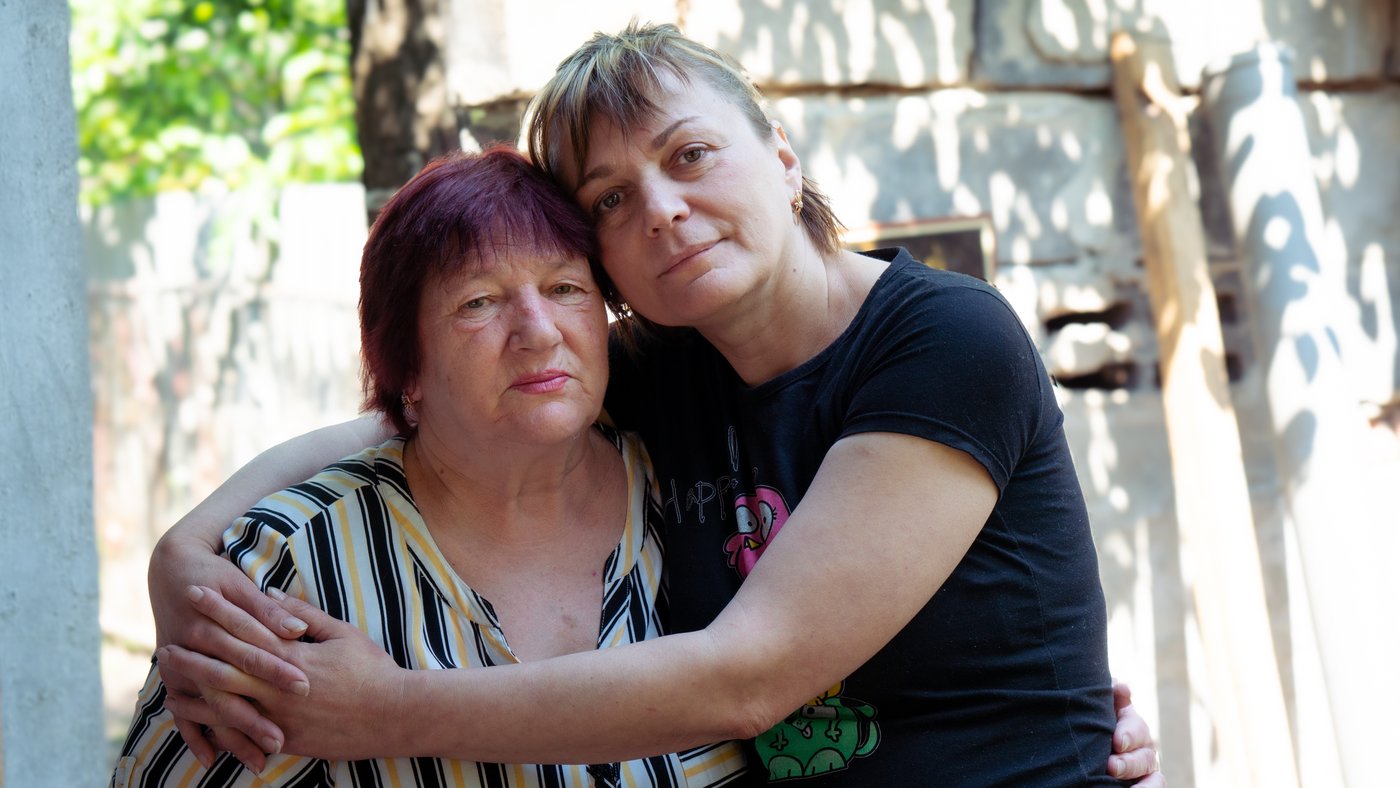
Rimma, her husband Volodymyr, their 15-year-old son Ivan and their seven cats were evacuated from their home in Donetsk oblast in December 2024. The family had lived all their lives in the town of Konstantinivka, which is now just 10km from the active frontline.
We ran out of everything – there was not even salt at our home
Rimma
Rimma recalls the moment when they decided to evacuate: “There was no income. My job as a vendor collapsed, businesses disappeared one by one. Pharmacies and stores were closed. My husband lost his work and started driving a taxi just to survive. We ran out of everything – there was not even salt at our home. So, we began looking for a way out.”
“We were reluctant to leave, as we had many goats and ducks. We left on 17 December 2024. I came back two weeks later because I couldn’t just abandon all my animals.”
Tamara, 66, had a similar experience. She evacuated with her disabled husband, Serhii, and their two dogs. Her village in Dvurechnaya, Kharkivska oblast remains under occupation as of July 2025.
Rimma and Tamara met in a shelter in Zernove and became friends.
Evacuation brings new struggles
Both Olena and Viktor have found temporary safety and relief in Hlukhiv, northern Ukraine. However, both continue to face significant challenges.
When Viktor arrived in Hlukhiv, he knew nothing of evacuations or how to navigate the process. He only knew that he wanted to reach his sister, who was living there. He first stayed at her home but was soon forced to check in to the local hospital as his health deteriorated.
After receiving treatment, he decided to move to a collective site, where we met him. He now receives an allowance for his disability. Unfortunately, the property title of his home was lost in a fire before he left. Without proper documentation, it is difficult to obtain compensation from the state for destroyed property. This would allow him to buy a new house elsewhere.
In times like these, we have to stick together
Tamara
For Rimma, the evacuation also brought new struggles. She is still of working age, and as such did not qualify for the state allowance for displaced people, meaning she could not receive any financial support. Her family received food and accommodation at the shelter, but that was temporary.
“Once, we residents even argued over something as small as a donated T-shirt. I never imagined it would come to this,” she recalls.
NRC supported Rimma with cash assistance. By April 2025, her family had rented a small house in Kharkiv, and she had found work as a supermarket vendor.
Tamara found a place close to Rimma’s house. She also received cash assistance from NRC and, in April 2025, left the shelter with her husband Serhii. As pensioners, they receive government payments, but “it’s barely enough to survive,” Tamara admits.
“I buy what I can for him and myself… It’s embarrassing, but I rely on free charity meals sometimes,” she says. Before the war, Tamara worked as an agronomist and spent years as a photojournalist for the local newspaper.
Now, she and Rimma lean on each other. “We meet often,” Tamara says. “In times like these, we have to stick together.”
Supporting people through evacuation and beyond
The struggles that displaced people face after reaching safety are a reminder that responsibility for their protection and wellbeing does not finish once evacuation has happened. Ensuring that civilians have access to the assistance and services they need is critical to ensure that they are not forced into impossible choices, such as moving back to unsafe areas, or not evacuating at all.
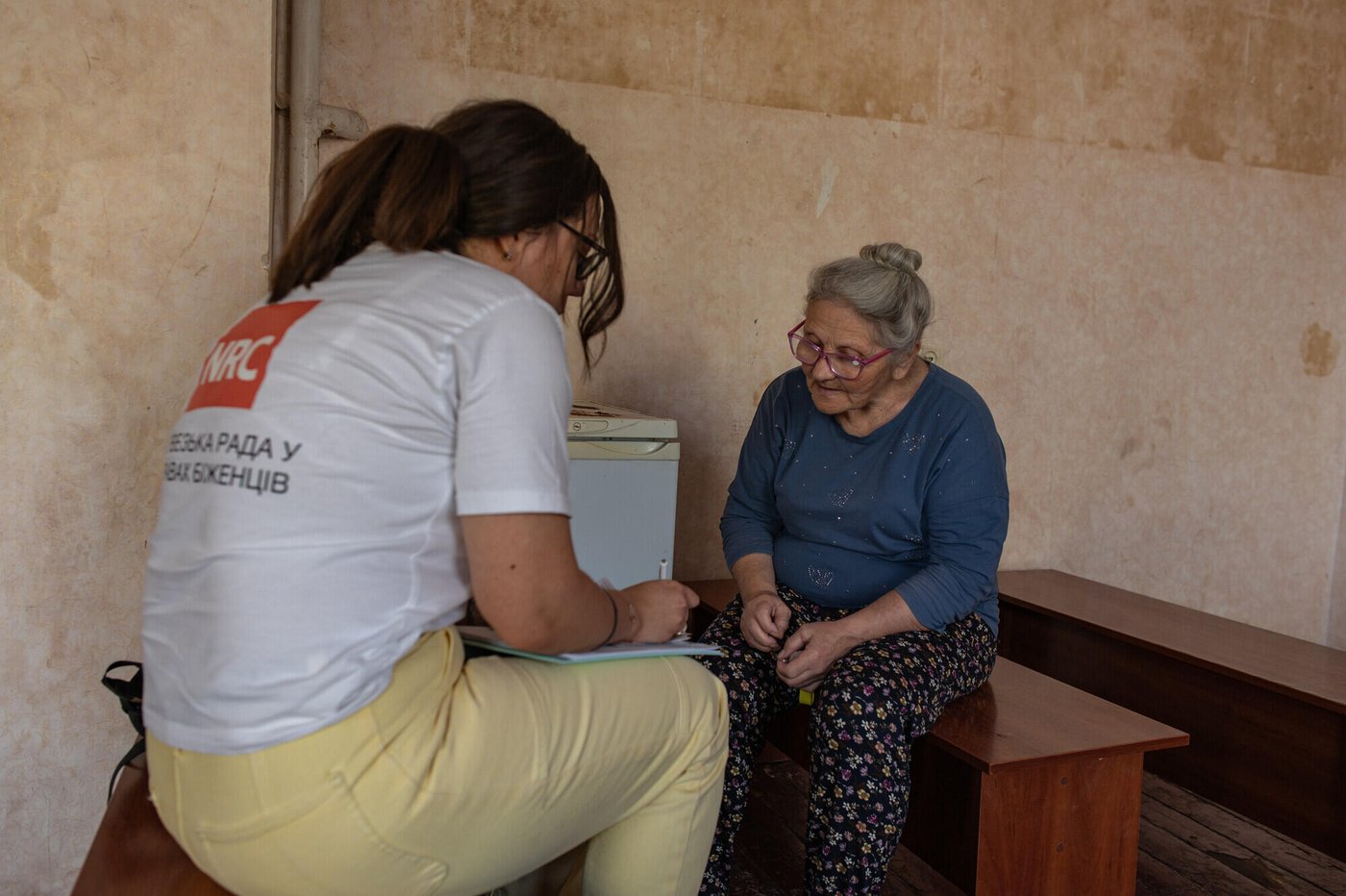
NRC is working closely with local communities, authorities and civil society organisations to ensure that people are safe and supported throughout an evacuation. We work to strengthen the technical capacity and operational ability of partners conducting evacuations, so that they can continue this crucial work in a safe and inclusive way.
Our approach focuses on three phases:
- Pre-evacuation: reaching out to places and people in need of support, providing information on evacuation options.
- Evacuation and relocation: the physical evacuation itself.
- Post-evacuation: follow-up assistance such as psychosocial support, referrals to key services, help with finding sustainable housing, cash assistance, and cash for protection support where severe risks still exist.
Stories like those of Olena, Viktor, Rimma and Tamara highlight how the most vulnerable often fall through the cracks in the evacuation cycle. At the same time, the exceptional work being done by local authorities, together with national and local humanitarian organisations, shows that there are ways to ensure that civilians can be evacuated safely and receive protection, assistance and services once they are displaced.
Read more about our work in Ukraine
Sign up to our newsletter to read more stories from around the world.