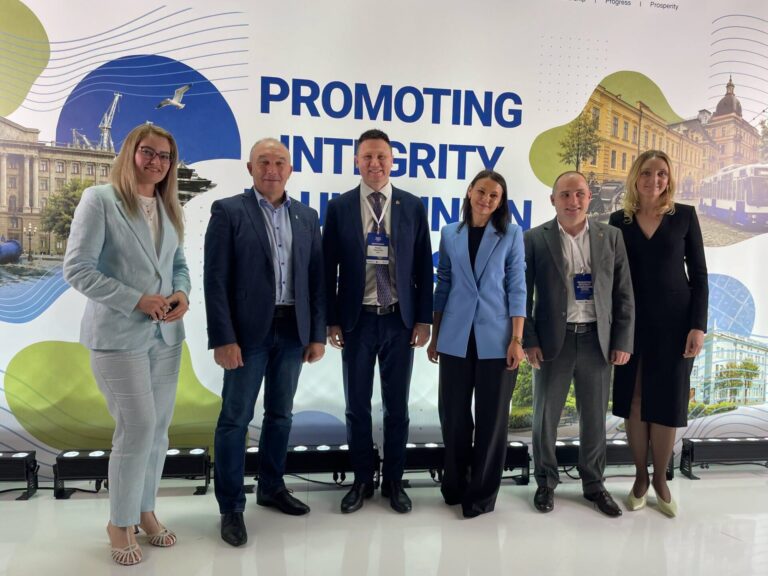
On 9 June, a public discussion titled “Building Integrity in Ukrainian Cities: The Example of Mykolaiv and Other Cities” took place in Kyiv. The event brought together mayors of Ukrainian cities, international partners, and good governance experts to present concrete achievements in integrity and transparency made by cities with the support of the European Union Anti-Corruption Initiative (EUACI).
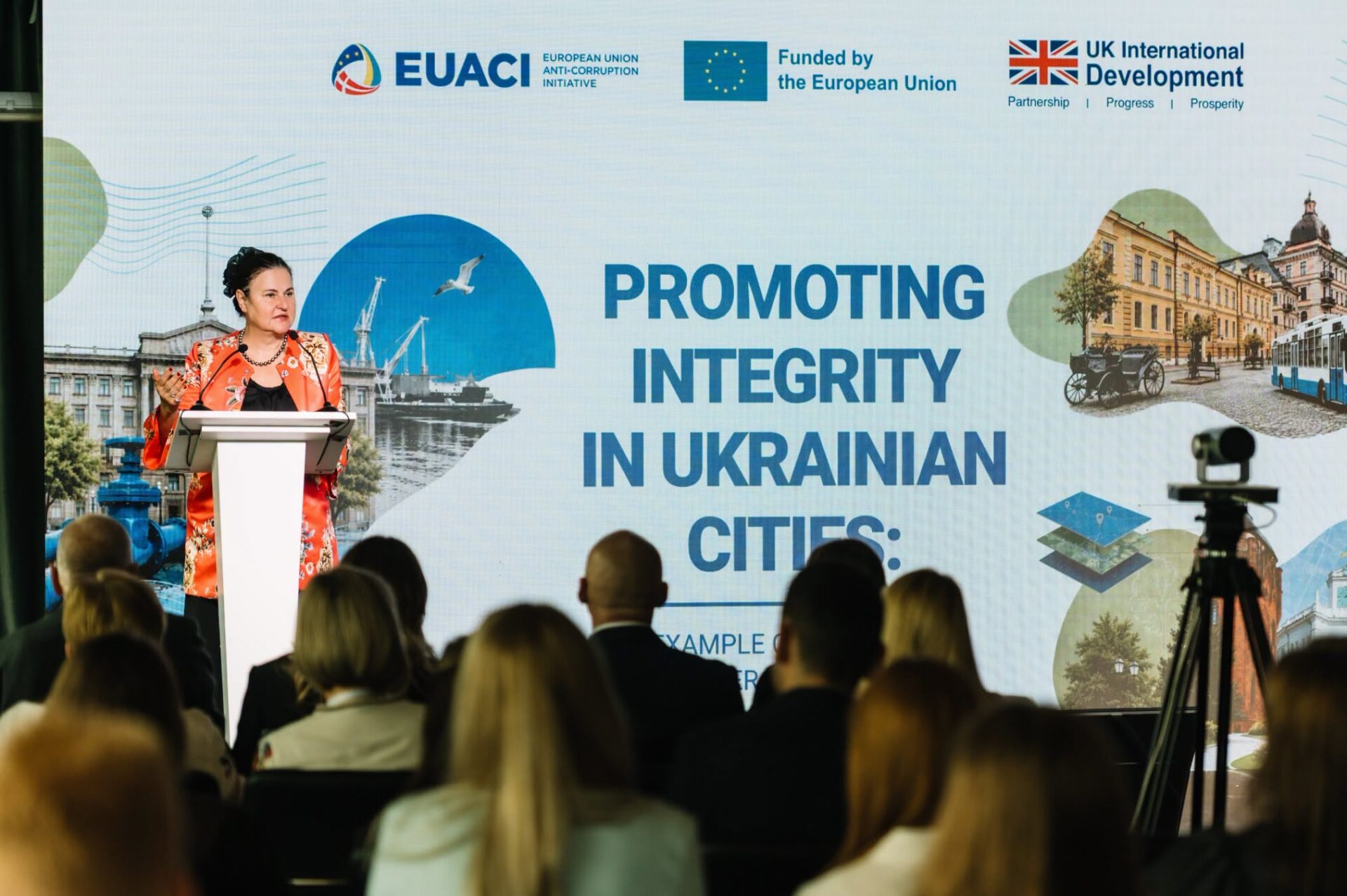
The event was opened by the Ambassador of the European Union (EU) to Ukraine Katarina Mathernova. In her welcoming remarks, she emphasised the role of local self-governance in bringing Ukraine closer to the EU and noted the progress that EUACI partner cities have achieved despite wartime challenges.
“Ukraine is carrying out reforms while simultaneously fighting for its national survival in a brutal war. I do not know any other country that has been doing these two things at the same time. There are countries that fight. There are countries that reform. Ukraine does both. Even under the pressure of daily shelling and power outages, Ukrainian communities continue to move forward. Through the EU Anti-Corruption Initiative — a programme worth nearly 60 million euros, funded by the European Union and implemented by Denmark — the EU stands alongside them, supporting local reformers, strengthening institutions, and helping build transparent, resilient, and sustainable cities,” – said Katarina Mathernova.
Kasper Mølbæk Jacobsen, Deputy Head of Mission at the Embassy of Denmark in Ukraine, also delivered welcoming remarks. In his speech, he noted that integrity is more than the absence of corruption — it is a culture of accountability, openness, and respect for the rules.
“We know that continuing reforms, building accountable institutions, and maintaining transparency is usually not easy, and doing so during a full-scale war is at least twice as difficult and at least twice as important. We see and appreciate what the Integrity Cities have achieved. These achievements reflect consistent, systemic work and demonstrate that being an Integrity City is a deliberate choice by Ukrainian cities. Just as the broader fight against corruption is a deliberate choice by Ukraine,” said Kasper Mølbæk Jacobsen.
Serhii Derkach, Deputy Minister for Communities and Territories Development of Ukraine, emphasized that cooperation between the state and cities works both ways: cities not only implement changes locally but also provide the state with ready-made solutions for scaling.
“Modern governance starts with quality and clear processes. When we digitize services, simplify procedures, and make them more transparent, people, communities, and the state all benefit. It is important that today cities are not just implementers of state policy but also a source of successful solutions and innovations. Many practices that originate at the local level later become the foundation for changes at the national level. Mykolaiv is one example of such an approach and partnership,” said Serhii Derkach.
During the event, Dmytro Yakymchuk, Head of the Integrity Cities Component, spoke about the activities of the EU Anti-Corruption Initiative in partner cities and approaches to working with integrity. Cooperation with cities began in 2018, and the Programme currently has seven partner cities: Zhytomyr, Mariupol, Nikopol, Sheptytskyi, Chernivtsi, Mykolaiv, and Poltava. During this time, the cities have progressed from corruption risk assessments to systemic changes: they approved and are implementing Integrity Plans, established effectively functioning internal audit departments, launched geographic information systems and electronic reception offices, introduced corporate governance and KPI systems for municipal enterprises, and changed the rules for technical supervision of construction.
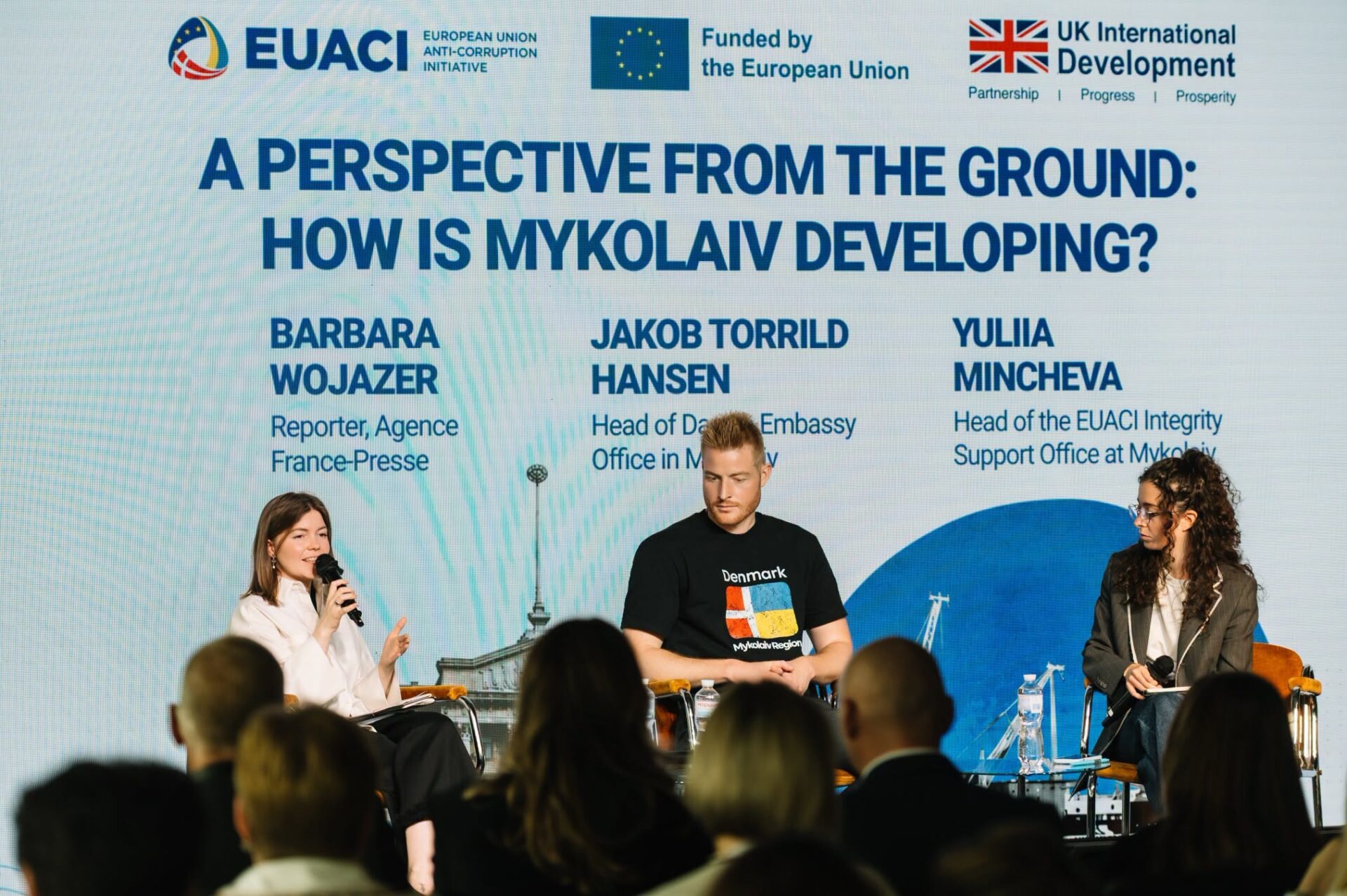


Mykolaiv joined the EUACI Integrity Cities in 2022, when Denmark took the city under its patronage for recovery. The achievements in integrity in Mykolaiv were discussed in an open interview format by Iryna Shyba, Deputy Head of EUACI, and Oleksandr Sienkevych, Mayor of Mykolaiv.
According to Oleksandr Sienkevych, over the years of cooperation, the city has turned integrity into a working tool. Updated procurement procedures yielded 40 million hryvnias in savings in 2025. Budget revenues from outdoor advertising increased 11-fold thanks to quality regulatory policy. The city approved a new structure for the city council and, for the first time in Ukraine, formed the composition of a supervisory board for a municipal enterprise in accordance with OECD corporate governance standards. Recently, the city council also approved the City Integrity Plan for 2026–2028 — a roadmap for the coming years. He added that the EUACI Integrity Support Office operates in the city, accompanying the implementation of these changes.
The panel discussion featured representatives of partner cities: Andrii Zalivskyi, Mayor of Sheptytskyi; Oleksandr Saiuk, Mayor of Nikopol; Kateryna Yamshchykova, Acting Mayor of Poltava; Halyna Shymanska, Acting Mayor of Zhytomyr; and Yevhenii Makhovikov, Deputy Mayor of Chernivtsi.
City leaders spoke about specific changes in their communities. In particular, in Sheptytskyi, Nikopol, Zhytomyr, and Chernivtsi, the management culture has changed thanks to open competitions, GIS implementation, and the launch of electronic reception offices for citizens. A notable example is Chernivtsi, where users of public amenity elements are determined through the Prozorro.Sales system. Thanks to this, at one of the auctions for the right to place a mobile structure, the starting price of the lot increased 39-fold — from 9,000 to over 350,000 hryvnias.
Poltava joined the Integrity Cities in 2025. Kateryna Yamshchykova, Acting Mayor of Poltava, shared that the city has begun work on new modules and restored public access to the geoportal, which had been closed since the beginning of the full-scale invasion. According to her, this makes urban planning information open and understandable for residents and businesses.
The tools launched with EUACI support will continue to operate after the programme ends, because for the cities this is no longer an external requirement but their own way of working.
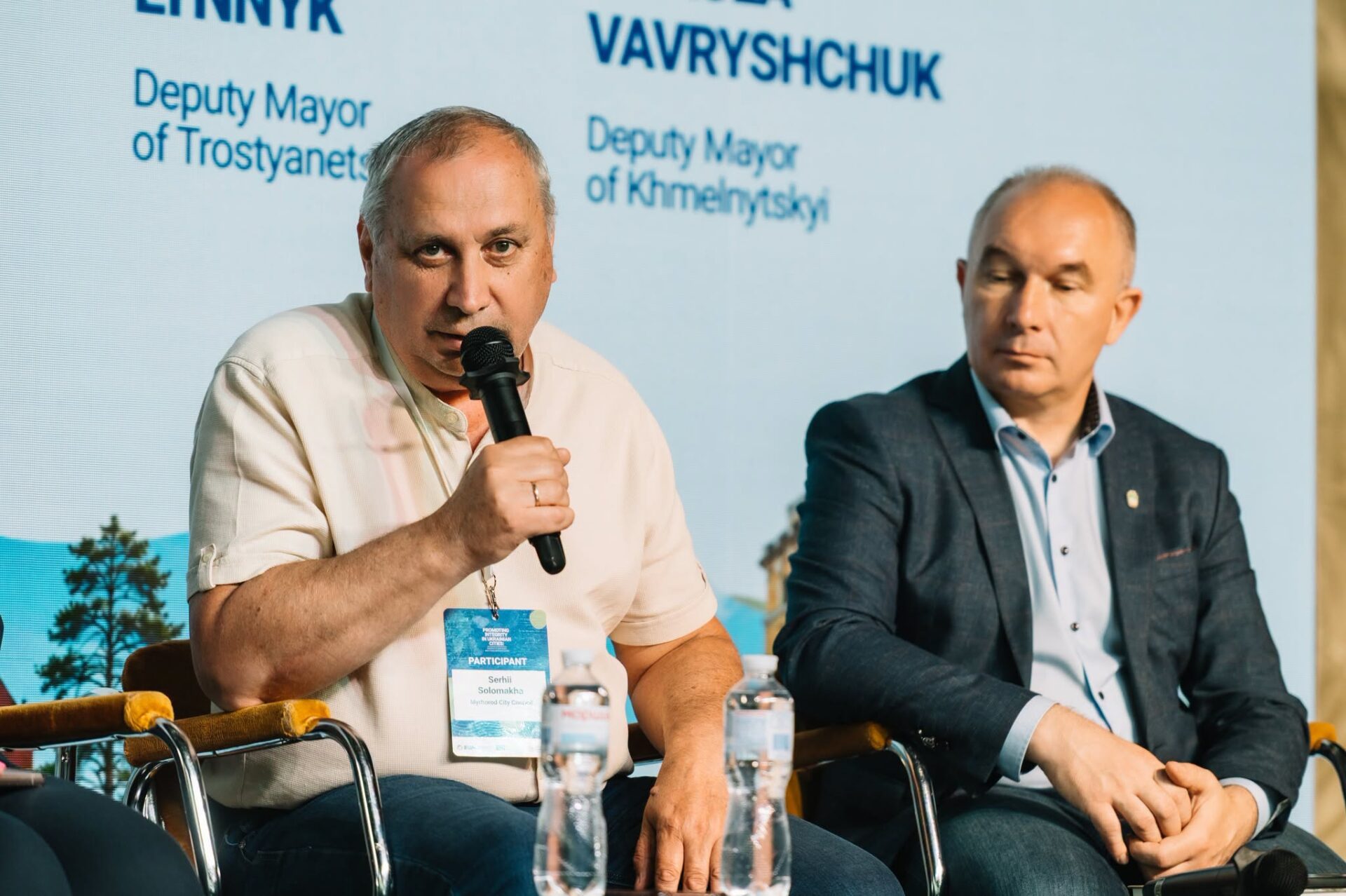
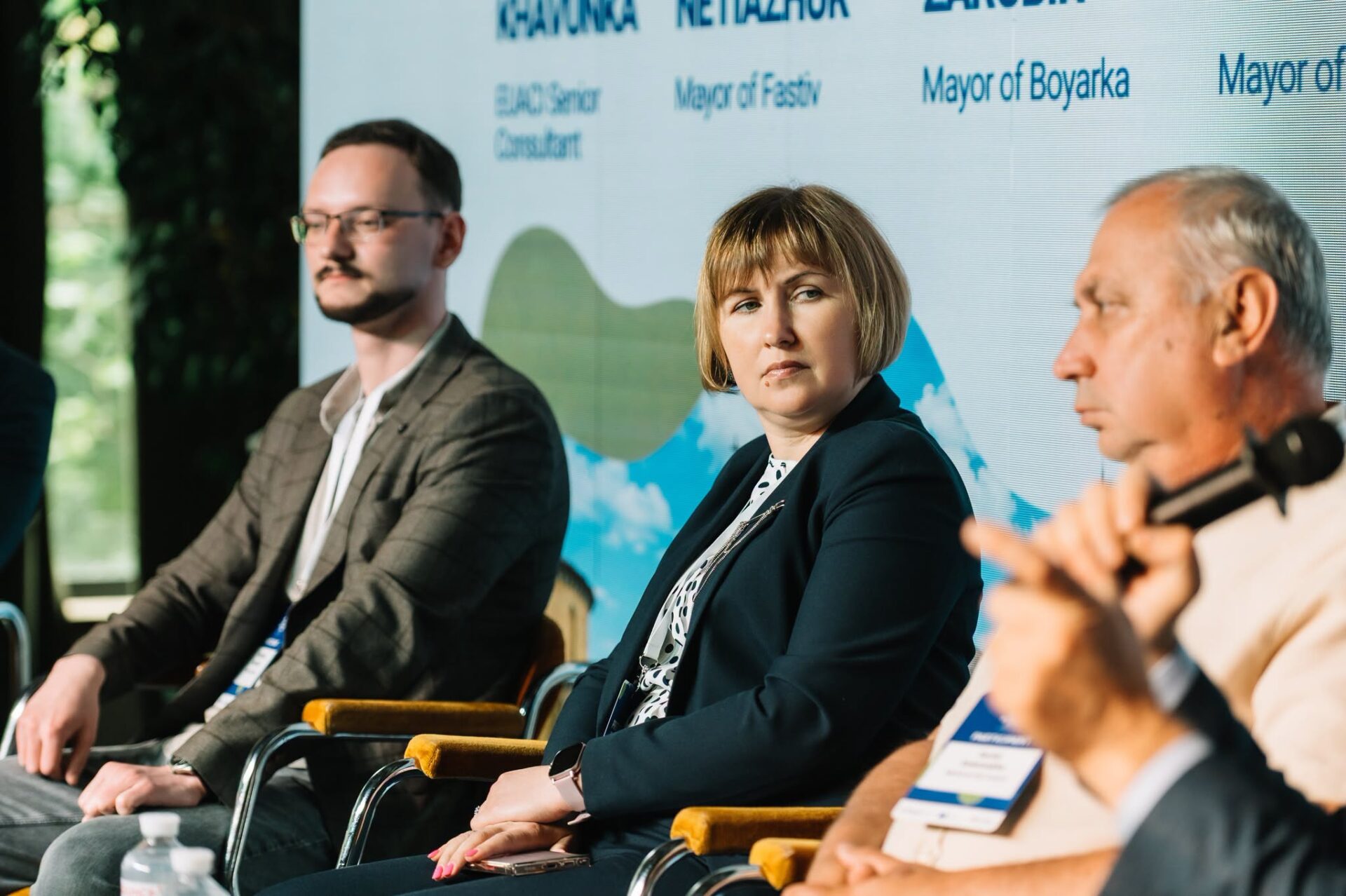
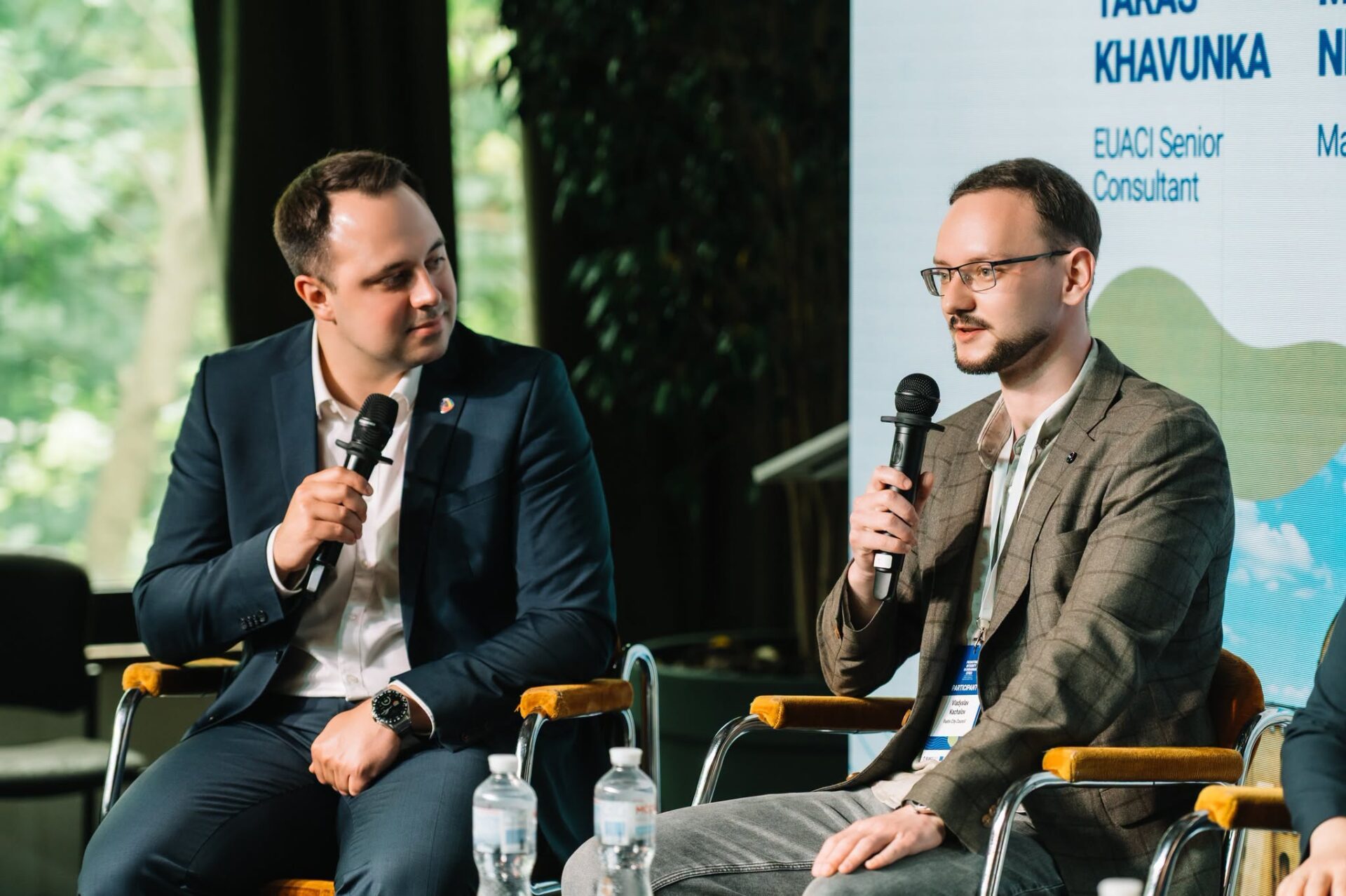
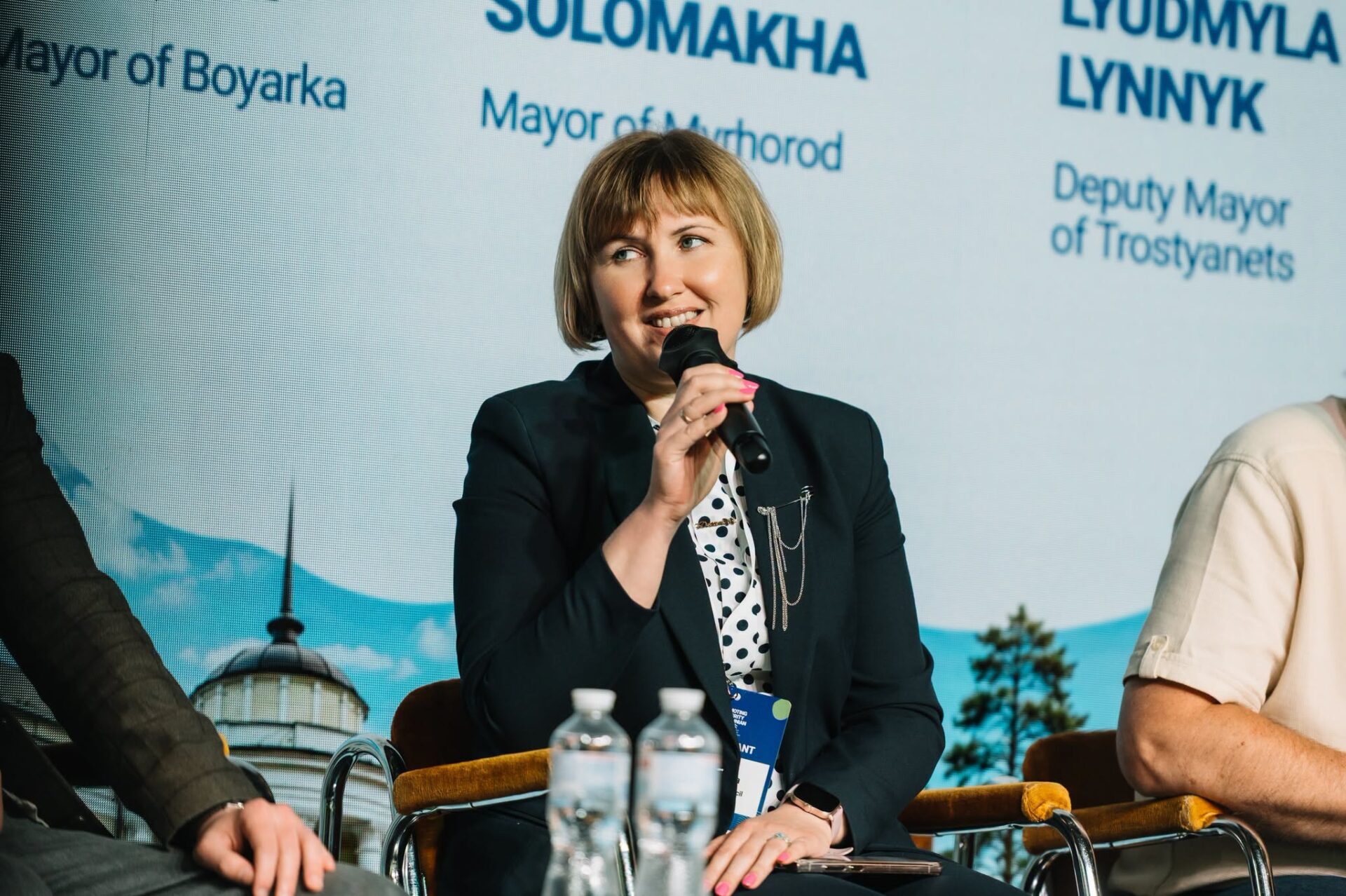
At the end of the event, a new format of cooperation between cities was presented — a community for exchanging experience and mutual support, which will be useful for those who want to adopt proven integrity practices and implement them locally. The first participants were Boiarka, Fastiv, Myrhorod, Khmelnytskyi, and Trostyanets.
Also public discussion “Building Integrity in Ukrainian Cities”, the EUACI launched a peer learning community for cities ready to adopt integrity practices. The first members are Boyarka, Fastiv, Myrhorod, Trostyanets, and Khmelnytskyi.
During the discussion, representatives of the cities spoke about their existing anti-corruption work and the practices from the EUACI’s Integrity Cities they are eager to adopt.

Hanna Salamatina, Head of Administration of the Boyarka City Council, shared that the city has developed an anti-corruption programme and appointed an anti-corruption officer who reviews all draft decisions of the council and executive committee. According to her, with active construction of social infrastructure underway, the partnership with EUACI can help ensure these processes are transparent and understood by the community.
Vladyslav Kachalov, anti-corruption specialist at Fastiv City Council, said the city has developed an anti-corruption programme with a corruption risk register, and anti-corruption officers are in place across its municipal enterprises. Fastiv is also working toward ISO 37001 certification — an international standard for anti-corruption management systems that builds a culture of integrity and transparency. To get there, the city is looking to learn from Integrity Cities’ best practices and get expert guidance on developing the required internal policies.
Serhiy Solomakha, Mayor of Myrhorod, said the city has made progress across several anti-corruption areas. But it was Mykolaiv’s experience — a city that went through this journey with EUACI — that showed him individual initiatives only deliver results when they form a coherent system. His priority of collaboration: transparent procurement and tenders as a tool for saving the city budget.
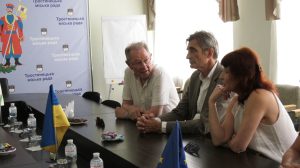
Yuriy Bova, Mayor of Trostyanets shared an approach to participatory budgeting: the city set up neighbourhood committees where residents decide how to spend funds in their own districts. The model has been running for six years, and its most tangible outcome, according to Bova, is public trust in local government.
Mykola Vavryshchuk, Deputy Mayor of Khmelnytskyi, spoke about the city’s geographic information system, which has been running for eight years and now hosts different open registries — from bike parking to urban planning documentation. Working with EUACI, the city plans to develop independent auditing of processes within the city council and its municipal enterprises.
The Integrity Cities have spent years showing that transparency and accountability are practical tools that change the lives of residents. Through this community, new cities will have the chance to see this from the inside, and make it part of how they govern.


The EU Anti-Corruption Initiative (EUACI) is the European Union’s anti-corruption programme in Ukraine, funded by the EU, the UK Foreign, Commonwealth & Development Office, and co-funded and implemented by the Ministry of Foreign Affairs of Denmark. The programme was launched in June 2017 and became a joint instrument for combating corruption in Ukraine.
Integrity Cities is a project of the EU Anti-Corruption Initiative (EUACI) designed to enhance the transparency and accountability of local authorities by optimizing internal procedures and processes, engaging communities in decision-making, and facilitating access to information. The project started in 2018 and initially covered five cities: Zhytomyr, Mariupol, Nikopol, Sheptytskyi, and Chernivtsi. In 2022, Mykolaiv joined the project, and in 2025, Poltava.