- A Border Town Between Attacks
- What Ukraine’s Energy System Requires
- Five German Channels
- Procurement Slower Than the War
- Delivery Is Not Commissioning
- Unequal Access for Municipalities
Germany is the largest bilateral donor to Ukraine’s energy sector, but the gap between delivered equipment and commissioned capacity keeps widening as Russian strikes redefine needs faster than procurement can follow.
Ukraine’s energy system is being repaired between attacks. Germany has provided more than 1.2 billion euros in emergency support since February 2022, yet municipalities, grid operators and donors describe the same bottleneck: generators, transformers and solar modules arrive, but installation, connection and maintenance often lag months behind the need they were meant to cover.
A Border Town Between Attacks
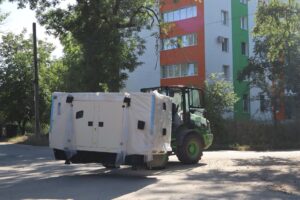
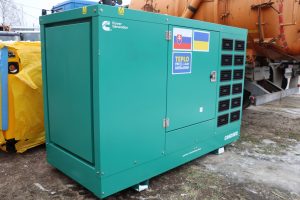
Before Russia’s full-scale invasion, around 16,000 people lived in Bilopillia near the border in the Sumy region. Today the figure is 6,000 to 7,000. Nearly all substations and heating plants in the area have been damaged, and the city’s critical facilities depend on emergency power. One of two high-capacity generators supplied through GIZ was destroyed in a Russian attack. The second survived because a protective net had been installed as a precaution. Even a working generator does not guarantee water and heat.
“A generator is good, but often we cannot put it into operation: the area is almost completely controlled by Russian drones,” says Bilopillia Mayor Yurii Zarko. Delivering fuel is an operation in itself. The municipality is therefore restructuring its system, connecting heating plants so they can back each other up and planning a solar plant with a capacity of around 500 kW.
International support operates under these conditions. Aid arrives between attacks, a restored facility can be damaged again, and needs can change before procurement is completed. Effectiveness is determined not by the number of units delivered, but by the full process from the submission of a needs request to commissioning: matching the need, timely delivery, installation, connection and maintenance.
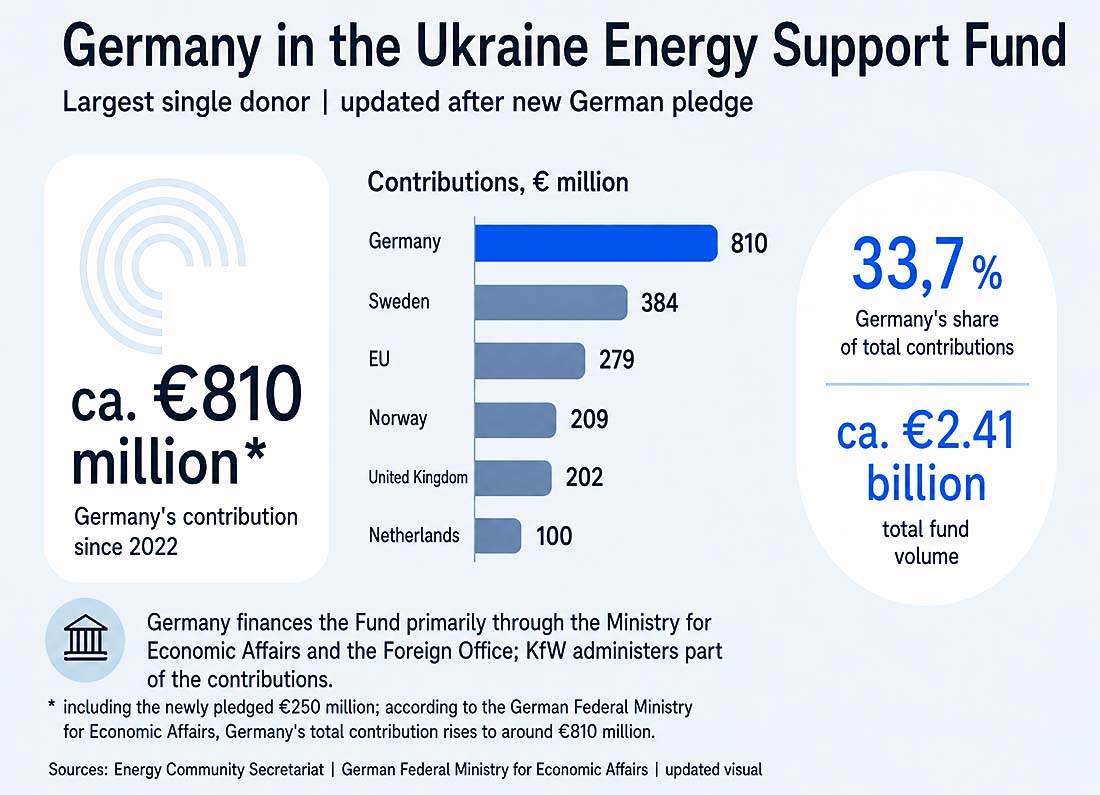
Germany is the largest state donor to Ukraine’s energy sector. According to the German Energy Agency dena, support since the start of the full-scale invasion exceeds 1.2 billion euros, provided through bilateral programs and through the Ukraine Energy Support Fund at the Energy Community Secretariat. Germany’s cumulative contribution to the Fund stood at around 557 million euros at the end of 2025. In September 2026, Berlin announced an additional 250 million euros, which according to Ukraine’s Ministry of Economy brings its total commitment to around 807 million euros.
What Ukraine’s Energy System Requires
The urgent needs were established through inquiries to Ukraine’s Ministry of Energy, the national energy company NEC Ukrenergo, distribution system operators and energy companies.
The Ministry of Energy identifies the restoration of grids and substations, decentralized generation and combined heat and power, energy storage, protection of energy facilities and gas infrastructure as critical. Needs requests are collected through the AidEnergy platform, with priority for facilities near the front line.
Ukrenergo names three tasks: equipment for transmission grids and substations, protection of key assets, and stronger connections with the European energy system. Distribution system operators need transformers, switchgear, specialized equipment and reserve stock held in secure areas. Municipalities need autonomous operation of water utilities, heating plants and hospitals, meaning combined heat and power units, local generation, energy storage and, in frontline areas, additional fuel and physical protection.
Five German Channels
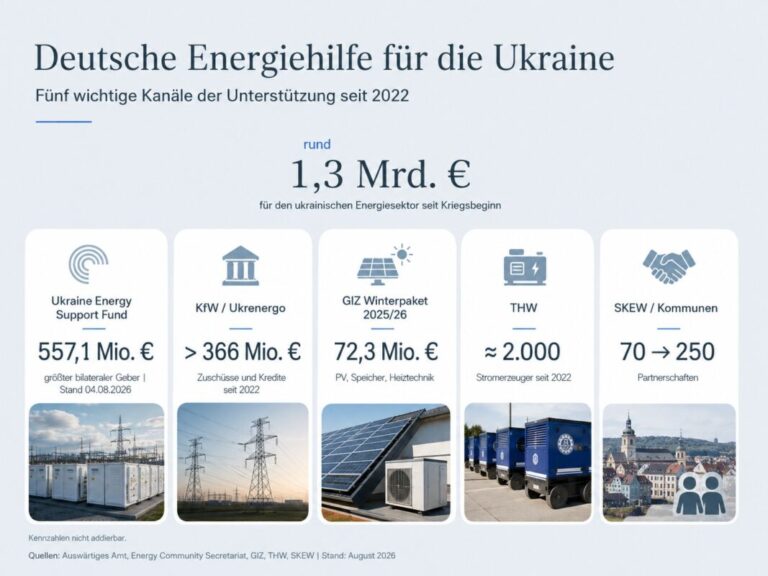
German aid comprises dozens of programs, with five channels forming its foundation.
The largest is the Ukraine Energy Support Fund, which uses German funding to procure transformers, generators and spare parts according to needs requests prioritized by the Ministry of Energy. Germany’s contribution stood at 557 million euros at the end of 2025, rising to a stated total of around 807 million euros after the additional 250 million euros announced in September 2026.
Since 2022, KfW Development Bank has provided Ukrenergo with more than 366 million euros in grants and loans for transmission grids, substations, cross-border connections, energy storage and physical protection. A separate package of around 170 million euros comprises eight projects, including protection of the South Ukraine and Rivne nuclear power plants.
GIZ supplies combined heat and power units, substations and battery storage systems and trains personnel. Some 65 million euros in new funding was provided in December 2025 and January 2026, and more than 34,000 units of equipment have been handed over in total, including in-kind donations from almost 90 German companies.
According to Germany’s Federal Ministry of the Interior, the Federal Agency for Technical Relief (THW) has delivered more than 1,700 generators abroad since 2022, most of them to Ukraine, procured with funding from the Federal Foreign Office and the Interior Ministry. The Service Agency Communities in One World (SKEW) supports municipal partnerships, whose number has grown from around 70 to 250, with funding instruments of up to 1 million euros. The figures refer to different periods and types of support and cannot be added together.
Procurement Slower Than the War
The central problem is the mismatch between the speed at which attacks change needs and the time required to procure and manufacture equipment. The gap is most visible in the Ukraine Energy Support Fund: after a needs request is approved, documents must be reviewed, financing secured, a tender conducted, a contract concluded, and production and delivery completed.
According to Olena Okulich, regional director of the German Eastern Business Association, individual procedures take up to six months. During that time the need may change or the critical season may already be over. Once equipment arrives, installation still has to be organized on site, often at the recipient’s own expense.
Adam Balogh, head of the Ukraine Energy Support Unit at the Energy Community Secretariat, says the usual window for submitting bids is three to four weeks, but that this is only one stage. “We are trying to procure within months what, in a normal energy sector cycle, is procured over years,” says Denis Prusakov, grants expert at the Secretariat. For a gas turbine in peacetime, specifications take one to two years, the tender up to a year, production and delivery two to three years, and installation another 12 to 18 months.
Okulich criticizes tenders in which German manufacturers lose out to cheaper suppliers from China and India, and proposes a benchmark of at least 30 percent participation by German companies. The association argues that quality and European standards should count alongside price.
Former Ukrenergo CEO Volodymyr Kudrytskyi, who led the company from 2020 to 2024, says he understands the manufacturers but suggests looking at the situation from a Ukrainian operator’s perspective. “Let us imagine that a Russian attack has destroyed a transformer on which the electricity supply of 300,000 families depends. The first option is to buy a transformer for approximately two million dollars and receive it in five months. The second is to pay around six million and wait a year and a half. Under wartime conditions, the decision is obvious.”
In large KfW programs, time constraints have a different cause. The bank finances transmission grids, substations, physical protection and other infrastructure that cannot be delivered as quickly as a generator or a mobile heating plant. KfW relies on Ukrainian partners in setting priorities and monitors the use of funds within its programs. “Such projects depend on prepared documentation, procurement, production cycles, construction work and the security situation,” Kudrytskyi says.
Delivery Is Not Commissioning
The volume of deliveries does not show how much capacity has actually entered service. In 2024 and 2025, GIZ procured equipment worth more than 54 million euros and delivered around 22,000 units donated by German companies, including more than 18,000 solar modules. There are no consolidated data on how many of those modules have been installed and how many are still waiting for inverters, connection or documentation.
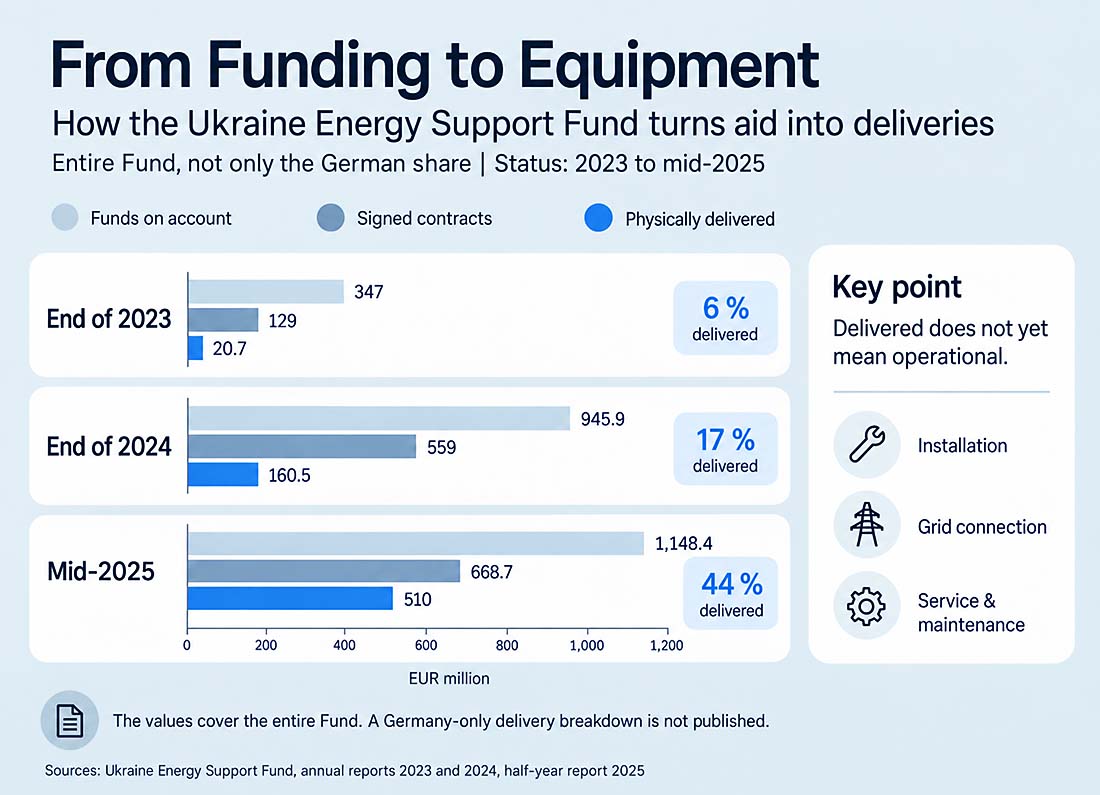
Hennadii Riabtsev, energy expert and director of special projects at the Psychea Scientific and Technical Center, argues that programs should be assessed by the share of equipment actually commissioned and integrated into the system, not by delivery volumes.
Stefan Sicars, UNIDO senior coordinator for Ukraine, criticizes the “endless purchase of generators” without checking whether the recipient can install and maintain them. In his assessment this is not a misappropriation of funds but an inefficient allocation. In southern Ukraine, donor-provided solar generation in some places exceeds local demand, but damaged grids prevent the surplus from being transmitted, and there are no storage systems in place.
Incompatibility is a further risk. DTEK representatives examined used equipment from RWE and EnBW, but large transformers and generators often did not match the parameters of Ukrainian thermal power plants. New equipment does not guarantee commissioning either. According to Oleksii Povolotskyi, head of the office for energy infrastructure recovery and development at DTEK, the main problem is completeness: a power plant unit cannot be commissioned with 99 percent of the equipment if one critical component is missing.
Tamara Vukovic, project manager at SKEW, lists installation, connection, service and fuel as the main causes of the gap between what is delivered and what is needed. By her assessment, around 60 percent of the aid matched the needs of municipalities.
Riabtsev describes the consequences of uncoordinated deliveries: “There must be no technological ‘zoo’ of incompatible components from different manufacturers and different countries at one site.” And, he adds: “Ukraine must create a different energy system, distributed, decentralized and controllable with the help of modern digital systems.”
Unequal Access for Municipalities
Municipal partnerships shorten the distance between need and aid. Municipalities formulate their requests directly, while German partners find funding or suppliers quickly. Okulich describes the model as one of the most efficient, involving more than 125 German cities and offering a format for smaller urgent requests. One example is the cooperation between Berlin’s Pankow district and Rivne, where partners work on the needs of hospitals, schools and infrastructure, and continuous contact makes it possible to respond to new damage.
The strength of direct partnerships is also their limitation: to use this channel, a municipality must have such a partnership in the first place. Large cities maintain international departments and have experience with applications. In a small municipality these functions often fall to a single person. Sicars points out that small municipalities are disadvantaged not because their needs are smaller, but because of the difficulty of translating those needs into a project a donor can understand. Frontline cities feel this most sharply, as their resources go into emergency repairs and evacuation.
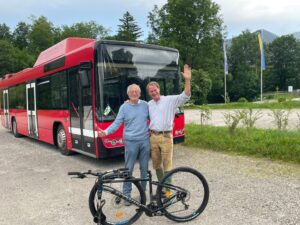
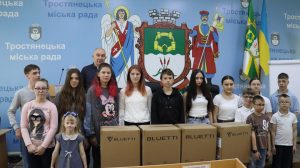
Trostianets illustrates the value of administrative capacity. Mayor Yurii Bova reports that once the municipality had completed procurement on time, installed the equipment and reported back to its partners, it was offered larger projects. The personal factor matters too: the then mayor of Montabaur, Gabriele Wieland, after meeting Bova, went with him to a hardware store and bought the required equipment with her own funds.
A network of regional coordinators supported by Germany’s Federal Ministry for Economic Cooperation and Development (BMZ), with one coordinator for 10 to 15 municipalities, is intended to make access more equal. A coordinator cannot replace technical specialists, however, and very small municipalities risk remaining outside the system. Vukovic considers the most effective programs to be those that combine financing with team training and long-term support. Municipalities without international departments, she says, need built-in support, meaning people able to formulate needs requests in the language of donors.
Reporting by Yulia Valova in collaboration with Serhiy Shturkhetskyy.
Funding acknowledgement: This article was produced with the support of the Official Development Assistance (ODA) Germany Grants program, powered by the Gates Foundation and run by the European Journalism Centre (EJC).