Skip to content
No results
  • News
  • Events
  • Projects
  • Business
  • Partner cities
    • Chattanooga, United States of America
    • Montabaur, Federal Republic of Germany
    • Gennevilliers, French Republic
    • Comune di Silvi, Italian Republic
    • Bystřice nad Pernštejnem, Czech Republic
    • Gmina Boguchwała, Republic of Poland
    • Gmina Kożuchów, Republic of Poland
  • Friendly municipalities
    • Cities of Marlow and Rugby, United Kingdom
    • Valmiera, Republic of Latvia
    • Kashihara, Japan
  • Industrial Park
  • Steel Dream
  • Interview
  • Friends
  • Publications
  • Master plan
  • Trostyanets city hromada
  • Editorial Policy
  • Trostyanets City Council
Trostyanets

Development of Global Partnerships

Login
Partners
  • News
  • Events
  • Projects
  • Business
  • Partner cities
    • Chattanooga, United States of America
    • Montabaur, Federal Republic of Germany
    • Gennevilliers, French Republic
    • Comune di Silvi, Italian Republic
    • Bystřice nad Pernštejnem, Czech Republic
    • Gmina Boguchwała, Republic of Poland
    • Gmina Kożuchów, Republic of Poland
  • Friendly municipalities
    • Cities of Marlow and Rugby, United Kingdom
    • Valmiera, Republic of Latvia
    • Kashihara, Japan
  • Industrial Park
  • Steel Dream
  • Interview
  • Friends
  • Publications
  • Master plan
Trostyanets

Development of Global Partnerships

Ukraine: Families in the firing line

  • Avatar photoEditorial Material
  • 18.03.2026
  • News
  • The Norwegian Refugee Council (NRC)
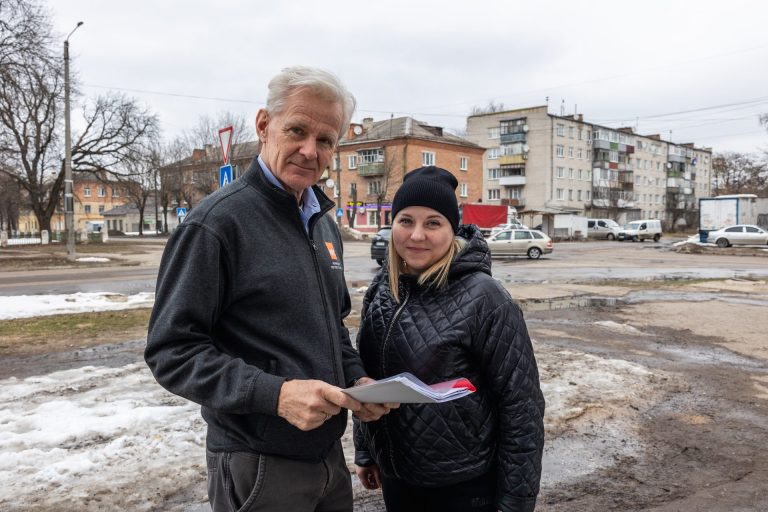
Norwegian Refugee Council's (NRC) secretary General, Jan Egeland talking to Natalia. Natalia received help to evacuate in recent weeks. Her town was close to the border, in an area where NRC and its partner organisation, Unity and Strength, support those who want to evacuate. Natalia was at her job in a petrol station when it was attacked from the air. The attack killed many of her coworkers and was the tipping point for Natalia and her family. Along with her elderly and sick parents, and her 9 year old son, they decided to flee. Despite the level of danger facing frontline communities, many people are reluctant to leaving owing to the uncertainty and a lack of adequate support for people once they have left their communities.

    Ukrainian families are being devastated by attacks on civilian homes and infrastructure, with a combination of air strikes and drone attacks compounding the exhaustion following four years of war and privation.

    Published 18. Mar 2026 – Updated 07. Apr 2026

    As war in the Middle East escalates, sustained violence against civilians in Ukraine must not be forgotten, warns Norwegian Refugee Council’s (NRC) Secretary General Jan Egeland during a visit to Sumy oblast, north-east Ukraine.

    “The level of destruction I witnessed in civilian areas in the northern city of Shostka, and from the communities close to the Russian border, is horrendous,” said Egeland. “Homes, schools and hospitals lie in ruins. The harrowing stories from families—of drones hunting civilians in broad daylight, of loved ones killed while fetching water or tending gardens—leave one speechless. Ukrainians have endured these daily attacks for years. While the world now watches new crises unfold elsewhere, communities in Ukraine continue to live under daily threat from the skies.”

    Across Ukraine, almost 10,000 drones and 500 missiles have been deployed by Russian forces since the start of the year, killing 349 civilians and injuring over 1,500. On the 10th of March, guided bombs killed at least two civilians and injured one in the city of Hlukhiv.

    Close to 50 of such attacks have taken place in the northern Sumy region since the start of the year resulting in widespread damage to power lines, communications and critical infrastructure, leaving communities without electricity and water. These attacks continue to push thousands into displacement amidst deteriorating humanitarian needs.

    “The cruel energy war left families without heating, electricity or water during months of bitter cold. The most vulnerable continue to suffer disproportionately, often being on the verge of running out of resources and resilience even before the winter started. For years, families across Ukraine have faced levels of bombardment that few places in the world experience day after day,” – said Egeland.

    After years of displacement have drained their savings, families now endure precarious living situations, turning to unsustainable coping strategies such as cutting back on healthcare or heating costs.

    NRC has been present in Ukraine since 2014 and provides vital support to civilians plunged into suffering and uncertainty following the escalation. Since 2022, NRC has provided more than 1.5 million people with humanitarian assistance across the country.

    In Sumy oblast NRC works to provide cash, legal aid and counselling, self-protection trainings and assistance, repairs for homes and community infrastructure, education and psychosocial support in schools for children and teachers. NRC has assisted 31,000 people in northern Sumy region in 2025, around one fifth of the total population.

    “Now is not the time for international donors and media to turn away. As the world’s attention shifts to new crises, Ukrainian civilians must not be forgotten. People in remote areas close to the frontline, like Shostka, must not become the invisible victims of this war. We urge donors to sustain life-saving support across Ukraine,” – said Egeland.

    Notes to editors:

    • Photos and stories of displaced Ukrainians are available for free use here.
    • According to data gathered by NRC in September 2025 from 113,845 internally displaced people (IDPs), who applied for assistance from NRC, vulnerable IDP households across Ukraine reported an average monthly income per household of 4,472 UAH (around 103 US dollars). They also reported resorting to three negative coping mechanisms to deal with the gap between their income and expenses. These were reduced health expenditure (20.2 per cent), reduced heating (13.2 per cent), spent savings (11.1 per cent).
    • IDPs who rent continue to experience a heavier rental burden than other population groups. Nationally, IDPs renters reported a median monthly rent of UAH 6,000 (around 140 US dollars) (IOM).
    • Data on protection of civilians in armed conflict shows that conflict-related violence killed at least 161 civilians and injured 757 in January 2026 and killed at least 188 people and injured 757 in February 2026 (OHCHR).
    • According to the International NGO Safety Organisation (INSO) 9,393 loitering munitions and 430 missiles have been launched by Russian Federation Armed Forces between January and February 2026.
    • According to INSO data, between January and March 10, 2026, 47 incidents involving loitering munitions, missiles, artillery and aerial bombs have impacted civilians and civilian infrastructure in the Shostka area, Sumy region.
    • Across Ukraine 3,712,000 people are still internally displaced as of January 2026 (IOM). A further 5,349,060 people have found refuge across Europe as of January 2026 (UNHCR).
    • Most IDPs continue to experience protracted displacement, with 71 per cent having been displaced for over two years (IOM).
    • The Ukraine Humanitarian Needs and Response Plan for 2025 received 1,500 million US dollars of the required 2,634 million US dollars (57 per cent coverage) (OCHA). In 2026, the Humanitarian Needs and Response Plan requires 2,304 million US dollars to support 4.1 million of the most vulnerable conflict-affected and displaced people in Ukraine (OCHA). As of 12 March, 574.4 million US dollars have been provided, covering 24.9 per cent of the plan (OCHA).
    • NRC has been present in Ukraine since 2014 and currently delivers cash, housing repairs and winter assistance, education, community protection, and legal assistance on housing, identity, and services – partnering with local organisations to meet displaced and conflict-affected families’ essential needs with dignity. Since the escalation of the war in 2022, NRC Ukraine has assisted over 1,500,000 individuals.

    For more information or to arrange an interview, please contact:

    • NRC global media hotline: [email protected], +47 905 62 329

    Tags
    # General Jan Egeland
    Share on Facebook Share on X (Twitter) Share on Telegram
    Avatar photo
    Editorial Material

    Municipal web-portal "Global Trostyanets" of Trostyanets city hromada was founded in May 2026 as a quick response and gratitude to all our international partners who helped our hromada survive after the occupation in 2022 and develop today. To some extent, this is a unique web resource, which has no analogues in Ukraine.

    Trostyanets is becoming an example of high-quality reconstruction and resilience. Financial support from the state and international partners has given us the chance to restore the housing stock, equip premises for the accommodation of displaced persons, create modern medical institutions, launch the educational process, revive and develop the municipal sphere.

    Today we have already demonstrated that restoration is not only about rebuilding buildings. It is the path to a qualitatively new level of life for municipality! We have become an example for the country and a convincing signal for foreign donors: aid brings tangible changes.

    Articles: 195
    Top stories

    Where opportunities lives

    Oleksandr Khoruzhenko Avatar
    Oleksandr Khoruzhenko
    30.10.2025
    Publications

    “Steel Dream”: Unique Project for Rebuilding Trostyanets

    Yuriy Bova Avatar
    Yuriy Bova
    02.08.2025
    Projects
    main partners

    Blagomay Deutsche Gesellschaft für Internationale Zusammenarbeit (GIZ) GmbH Envitec LLC Mondelēz International Polish Center for International Aid Swiss Confederation The Association Internationale de Coopération Médicale (AICM) U-LEAD with Europe UNDP USAID HOVERLA

    More stories
    July 8, 2026

    /

    News
    Lavender honey from Trostyanets park “EDEM” reached Japan
    July 8, 2026

    /

    News
    Voluntary Fire Brigades recieved new equipments from “Partnership Fund for a Resilient Ukraine”
    July 3, 2026

    /

    News
    Hospitals received medical humanitarian aid from The Association Internationale de Coopération Médicale
    June 28, 2026

    /

    News
    Results of work at URC-2026 in Gdansk. Part 2
    June 28, 2026

    /

    News
    Results of work at URC-2026 in Gdansk. Part 1
    our partners

    • Video
    • Documents

    • Trostyanets city hromada
    • Editorial Policy
    • Trostyanets City Council

    Municipal web-portal "Global Trostyanets" of Trostyanets city hromada was founded in May 2026 as a quick response and gratitude to all our international partners who helped our hromada survive after the occupation in 2022 and develop today. To some extent, this is a unique web resource, which has no analogues in Ukraine.

    Trostyanets is becoming an example of high-quality reconstruction and resilience. Financial support from the state and international partners has given us the chance to restore the housing stock, equip premises for the accommodation of displaced persons, create modern medical institutions, launch the educational process, revive and develop the municipal sphere.

    Today we have already demonstrated that restoration is not only about rebuilding buildings. It is the path to a qualitatively new level of life for municipality! We have become an example for the country and a convincing signal for foreign donors: aid brings tangible changes.

    Contact information

    • Opening hours: 9AM - 5PM
    • Website: Trostyanets City Council, Ukraine
    • Address: 42600, Trostyanets city, Myru str., 6
    • Email: mail@trostyanets-miskrada.gov.ua
    • Telephone: +380 545 85 13 80

    Copyright © 2026 - Global Trostyanets