Skip to content
No results
  • News
  • Events
  • Projects
  • Business
  • Partner cities
    • Chattanooga, United States of America
    • Montabaur, Federal Republic of Germany
    • Gennevilliers, French Republic
    • Comune di Silvi, Italian Republic
    • Bystřice nad Pernštejnem, Czech Republic
    • Gmina Boguchwała, Republic of Poland
    • Gmina Kożuchów, Republic of Poland
  • Friendly municipalities
    • Cities of Marlow and Rugby, United Kingdom
    • Valmiera, Republic of Latvia
    • Kashihara, Japan
  • Industrial Park
  • Steel Dream
  • Interview
  • Friends
  • Publications
  • Master plan
  • Trostyanets city hromada
  • Editorial Policy
  • Trostyanets City Council
Trostyanets

Development of Global Partnerships

Login
Partners
  • News
  • Events
  • Projects
  • Business
  • Partner cities
    • Chattanooga, United States of America
    • Montabaur, Federal Republic of Germany
    • Gennevilliers, French Republic
    • Comune di Silvi, Italian Republic
    • Bystřice nad Pernštejnem, Czech Republic
    • Gmina Boguchwała, Republic of Poland
    • Gmina Kożuchów, Republic of Poland
  • Friendly municipalities
    • Cities of Marlow and Rugby, United Kingdom
    • Valmiera, Republic of Latvia
    • Kashihara, Japan
  • Industrial Park
  • Steel Dream
  • Interview
  • Friends
  • Publications
  • Master plan
Trostyanets

Development of Global Partnerships

Ukrainian Mayoral Delegation Visits Denver, Korbel School

  • Avatar photoEditorial Material
  • 03.05.2023
  • EventsNews
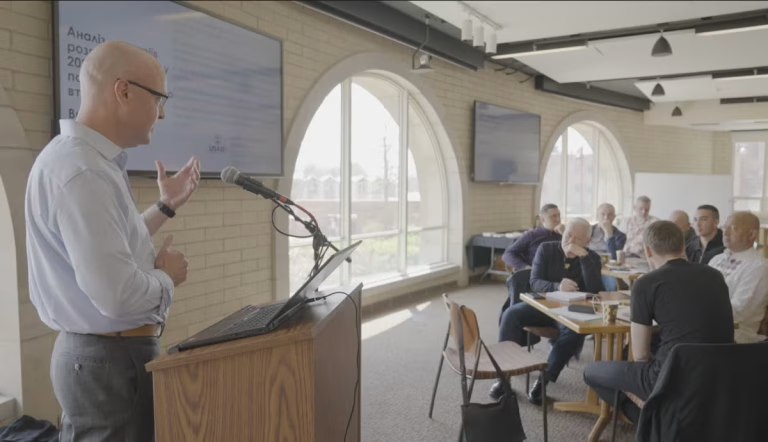
Korbel School Professor Keith Gehring speaks to a group of Ukrainian mayors.


    Faculty & Staff
    , In the World  •

    May 3, 2023

    The group of Ukrainian mayors who visited the University of Denver last week may not have been a typical delegation to the annual Cities Summit of the Americas, but their presence on DU’s campus was impactful, nonetheless.

    The five mayors spoke with Korbel School of International Studies professors Rachel Epstein, Martin Rhoades and Lapo Salucci about their experiences leading their citizens through Russia’s invasion of Ukraine, a war which has displaced more than 14 million people. The roundtable included mayors Vitaliy Klychko of Kyiv, Ihor Terekhov of Kharkiv, Ivan Federov of Melitopol, Yuriy Bova of Trostyanets and Oleksandr Kodola of Nizhyn.

    Despite the heavy human and infrastructural toll the war has taken on their cities, the mayors centered much of the discussion on the regrowth that has been achieved in the past few months.

    Mayor Kodola of Nizhyn, a northern city in Ukraine’s Chernihiv region, spoke through a translator. He said the fighting in Nizhyn lasted a month and a half, resulting in many casualties and much destruction.

    But he said he was proud of how the city has rebuilt following the conflict.

    “For more than one year, we’ve given life back to our city and restored [it] to full capacity,” he said. “My task as the mayor is to restore life in the city.”

    Bova is mayor of Trostyanets, which was occupied by Russia on Feb. 24, 2022, and liberated just over a month later.

    He said that Russians tortured and robbed Trostyanets’ citizens, stealing all of the city’s computers.

    “But almost 99% of people have returned to the city,” Bova said.

    He thanked the U.S. for its role in supporting Ukraine through the war, saying, “[A] huge part of restoration of the city is due to international connections.”

    Following the mayors’ conversation with professors Epstein, Rhoades and Salucci, the group attended a presentation by Korbel professor Keith Gehring that detailed several possible scenarios for Ukraine’s recovery, as determined by the Frederick S. Pardee Center for International Futures.

    Gehring shared that the Pardee Center had developed four scenarios for Ukraine’s future pre-invasion by Russia—and said that the applicability of those predictions is limited but shouldn’t be entirely discounted.

    Gehring then outlined four post-invasion scenarios: No war, war, success and misfortune.

    The first scenario, “no war,” is counter factual, Gehring said.

    “We do this so that we can baseline existing dynamics in the model and compare that with the alternative scenarios that are closer to our reality,” he said.

    The other three scenarios are a closer representation of what is currently happening in Ukraine.

    “We have to make bold assumptions, so the effects of war are resident in all three scenarios, but they also assume a stagnation or cessation in conflict by 2033,” Gehring said.

    The “war” scenario includes approximated shocks to economic growth, trade, agriculture and the energy system and other potential shifts caused by Russia’s invasion.

    The “success” scenario involves meeting top governmental targets for recovery in multiple categories, while the “misfortune” scenario sees recovery efforts fail to meet not only Ukrainian governmental goals, but also World Bank and European Commission targets.

    Among Gehring’s key takeaways was a warning about Ukraine’s potential reliance on foreign aid—a factor that all the mayors expressed gratitude for during the roundtable discussion.

    “In the near term, of course, aid will be essential. But that, too, is problematic,” he said. “[That] dependency [could] limit long-term growth as well the interests of the international community, which waxes and wanes.”

    Key Details of the Visit:

    • Delegation Members: The group included Vitali Klitschko (Kyiv), Ihor Terekhov (Kharkiv), Ivan Fedorov (Melitopol), Yuriy Bova (Trostyanets), and Oleksandr Kodola (Nizhyn).
    • Key Discussions: The mayors met with University of Denver Korbel School of International Studies professors, focusing on governance under fire, supporting internally displaced persons (IDPs), and infrastructure restoration.
    • Objectives: The visit aimed to raise awareness of the challenges facing local self-governance in Ukraine and to secure international support for recovery efforts.
    • Key Messages: Mayor Klitschko emphasized the resilience of local leaders and the urgent need for continued international solidarity. University of Denver +4

    The delegation’s presence served as a powerful testament to the role of local governments in Ukraine’s resistance and survival. University of Denver

    Tags
    # Denver
    Share on Facebook Share on X (Twitter) Share on Telegram
    Avatar photo
    Editorial Material

    Municipal web-portal "Global Trostyanets" of Trostyanets city hromada was founded in May 2026 as a quick response and gratitude to all our international partners who helped our hromada survive after the occupation in 2022 and develop today. To some extent, this is a unique web resource, which has no analogues in Ukraine.

    Trostyanets is becoming an example of high-quality reconstruction and resilience. Financial support from the state and international partners has given us the chance to restore the housing stock, equip premises for the accommodation of displaced persons, create modern medical institutions, launch the educational process, revive and develop the municipal sphere.

    Today we have already demonstrated that restoration is not only about rebuilding buildings. It is the path to a qualitatively new level of life for municipality! We have become an example for the country and a convincing signal for foreign donors: aid brings tangible changes.

    Articles: 195
    Top stories

    Where opportunities lives

    Oleksandr Khoruzhenko Avatar
    Oleksandr Khoruzhenko
    30.10.2025
    Publications

    “Steel Dream”: Unique Project for Rebuilding Trostyanets

    Yuriy Bova Avatar
    Yuriy Bova
    02.08.2025
    Projects
    main partners

    Blagomay Deutsche Gesellschaft für Internationale Zusammenarbeit (GIZ) GmbH Metinvest Mondelēz International Polish Center for International Aid Swiss Confederation The Association Internationale de Coopération Médicale (AICM) U-LEAD with Europe UNDP USAID HOVERLA

    More stories
    July 3, 2026

    /

    News
    Hospitals received medical humanitarian aid from The Association Internationale de Coopération Médicale
    June 28, 2026

    /

    News
    Results of work at URC-2026 in Gdansk. Part 2
    June 28, 2026

    /

    News
    Results of work at URC-2026 in Gdansk. Part 1
    June 25, 2026

    /

    News
    Ai Engineering signed a new agreement with Ukrainian company “Metinvest” and the Municipality of Trostyanets
    June 24, 2026

    /

    Publications
    SHIFT-R paves the way for new international collaborations at “Society Expo” in Skellefteå (Sweden)
    our partners

    • Video
    • Documents

    • Trostyanets city hromada
    • Editorial Policy
    • Trostyanets City Council

    Municipal web-portal "Global Trostyanets" of Trostyanets city hromada was founded in May 2026 as a quick response and gratitude to all our international partners who helped our hromada survive after the occupation in 2022 and develop today. To some extent, this is a unique web resource, which has no analogues in Ukraine.

    Trostyanets is becoming an example of high-quality reconstruction and resilience. Financial support from the state and international partners has given us the chance to restore the housing stock, equip premises for the accommodation of displaced persons, create modern medical institutions, launch the educational process, revive and develop the municipal sphere.

    Today we have already demonstrated that restoration is not only about rebuilding buildings. It is the path to a qualitatively new level of life for municipality! We have become an example for the country and a convincing signal for foreign donors: aid brings tangible changes.

    Contact information

    • Opening hours: 9AM - 5PM
    • Website: Trostyanets City Council, Ukraine
    • Address: 42600, Trostyanets city, Myru str., 6
    • Email: mail@trostyanets-miskrada.gov.ua
    • Telephone: +380 545 85 13 80

    Copyright © 2026 - Global Trostyanets