Skip to content
No results
  • News
  • Events
  • Projects
  • Business
  • Partner cities
    • Chattanooga, United States of America
    • Montabaur, Federal Republic of Germany
    • Gennevilliers, French Republic
    • Comune di Silvi, Italian Republic
    • Bystřice nad Pernštejnem, Czech Republic
    • Gmina Boguchwała, Republic of Poland
    • Gmina Kożuchów, Republic of Poland
  • Friendly municipalities
    • Cities of Marlow and Rugby, United Kingdom
    • Valmiera, Republic of Latvia
    • Kashihara, Japan
  • Industrial Park
  • Steel Dream
  • Interview
  • Friends
  • Publications
  • Master plan
  • Trostyanets city hromada
  • Editorial Policy
  • Trostyanets City Council
Trostyanets

Development of Global Partnerships

Login
Partners
  • News
  • Events
  • Projects
  • Business
  • Partner cities
    • Chattanooga, United States of America
    • Montabaur, Federal Republic of Germany
    • Gennevilliers, French Republic
    • Comune di Silvi, Italian Republic
    • Bystřice nad Pernštejnem, Czech Republic
    • Gmina Boguchwała, Republic of Poland
    • Gmina Kożuchów, Republic of Poland
  • Friendly municipalities
    • Cities of Marlow and Rugby, United Kingdom
    • Valmiera, Republic of Latvia
    • Kashihara, Japan
  • Industrial Park
  • Steel Dream
  • Interview
  • Friends
  • Publications
  • Master plan
Trostyanets

Development of Global Partnerships

Ukrainian doctors describe delivering babies as Russia shelled the hospital

  • Avatar photoEditorial Material
  • 26.04.2022
  • Publications
Yuriy Bova, mayor of Trostyanets, Ukraine, shows one of the Russian tanks he says was firing on the town's hospital, on April 19.

    NPR | By Franco Ordoñez

    Olena Lysenko

    Published April 26, 2022 at 5:08 AM EDT
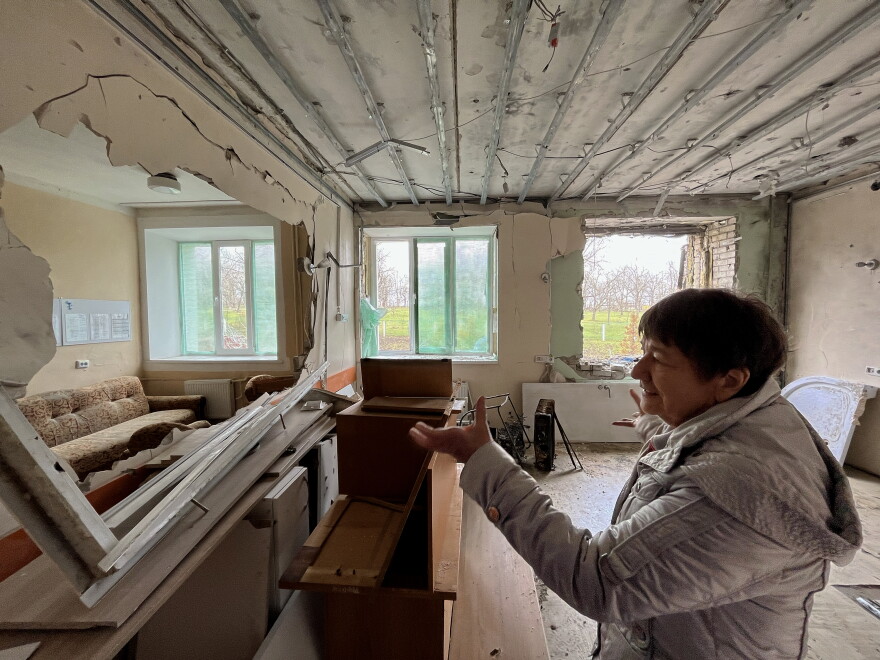
    Dr. Tetiana Sydorenko shows what was left of the Trostyanets hospital's maternity ward after the Russian bombardment, on April 19. She says the shelling was everywhere, "it was hell."
    Dr. Tetiana Sydorenko shows what was left of the Trostyanets hospital’s maternity ward after the Russian bombardment, on April 19. She says the shelling was everywhere, “it was hell.”

    Updated May 4, 2022 at 3:08 PM ET

    TROSTYANETS, Ukraine — Walking through the heavily shelled second floor maternity ward, Dr. Hanna Shvetsova stops to stare at a glossy picture of a blond baby lying on a white pillow. It’s the kind of image seen in countless ads for baby products.

    It’s now covered in bullet holes.

    Six babies were delivered here at Trostyanets Hospital during the Russian occupation, including a pair of twins.

    Shvetsova says most of those were conducted in the hallways, where they felt a bit safer working between two extra walls.

    “I could have died three times with my patients,” she says. “First, when the tank was shooting at us. Second, when the ceiling was falling.”

    She says the third was when she decided to walk a new mother home around the tanks, through a forest that she later learned was full of land mines.

    The liberation of this small northern Ukrainian town just 22 miles from the Russian border after four weeks of occupation was not only a great victory for the people of Trostyanets, but a source of pride for the country.

    Yet, a month after the Russian forces left, local officials are only just beginning to understand the long-term impacts of the devastating Russian occupation.

    The bridge into town remains split in two. The factories that employed thousands of workers have been destroyed.

    And in a sign of what other liberated Ukrainian communities will face, the biggest challenge for Trostyanets is likely not rebuilding the town’s infrastructure, but recovering from the psychological scars of the occupation.

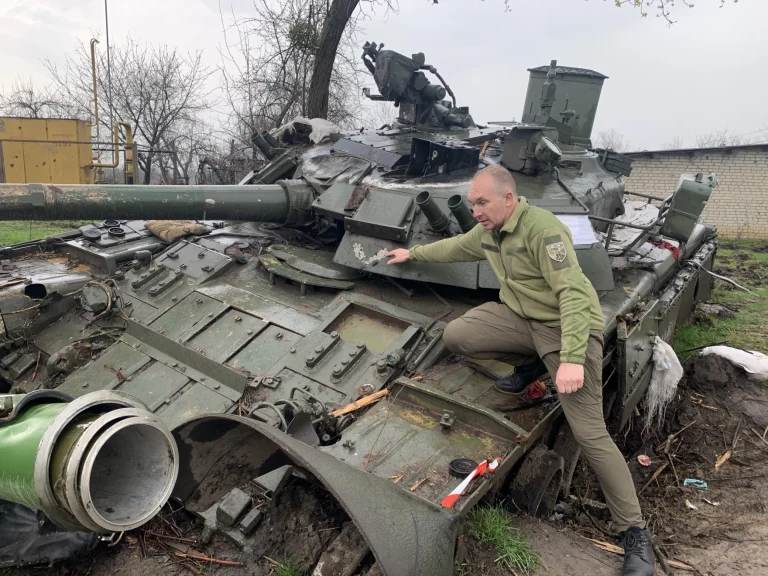
    Yuriy Bova, mayor of Trostyanets, Ukraine, shows one of the Russian tanks he says was firing on the town's hospital, on April 19.
    Yuriy Bova, mayor of Trostyanets, Ukraine, shows one of the Russian tanks he says was firing on the town’s hospital, on April 19.

    Thousands of jobs were lost

    The first Russian troops arrived in Trostyanets on Feb. 24, day one of the war, as Russian forces started their initial push toward the west.

    The Russians quickly took control of City Hall and the local police department.

    Thousands of jobs were lost when the local chocolate factory and wood factory were destroyed. He said hundreds more were lost when the bombed-out train station stopped working.

    Zhenya Skorohodov, an administrator at City Hall, says it will likely take years to rebuild.

    “It’s very hard because the infrastructure of the city is almost destroyed,” Skorohodov says. “So nowadays, we don’t have any abilities to go back to normal life because it needs much financial resources to reconstruct the infrastructure subjects in the city.”

    Wrecked infrastructure can be rebuilt, but deeper scars will last a long time

    But Trostyanets’ mayor, Yuriy Bova, is confident that they’ll get the money. The infrastructure, he says, will be rebuilt. He worries more about the scars on people’s minds.

    Fifty-two residents were killed, including two children, before Ukrainian forces were able to wrest back control of the city. There are 18 residents still missing.

    Bova says most everyone in the community lost a family member or a friend.

    Some watched them die.

    And some also had to live alongside the dead because they did not want to risk leaving their homes and getting killed by the Russians — or caught in the crossfire.

    “The trauma that people experienced will last for years,” Bova tells NPR. “It’s something that can’t be cured by humanitarian aid.”

    Many fear the Russians’ return

    Many resident fear the Russians will return again. They imagine troops sitting and waiting on the border, which is just 30 minutes away.

    “It’s hard to imagine this happening again,” says Myroslav Shylo, a local baker. “I don’t know if I could survive psychologically.”

    During the occupation, Shylo, 23, secretly secured flour so that he could make bread and stole fuel from the gas station so that he could deliver it to the neediest residents, including patients and doctors at the hospital.

    On a recent day, hundreds of desperate residents were standing in line outside his shop waiting to get a loaf of bread for their families.

    “You can’t buy anything,” Shylo says. “This is the only place you can get food.”

    Myroslav Shylo, 23, helps a young mother get through the long line at his bakery so that she can get bread for her family, on April 20, in Trostyanets, Ukraine.
    Myroslav Shylo (center), 23, is outside his bakery as Ukrainians line up waiting for bread, on April 20, in Trostyanets, Ukraine.

    Attacks tore through the hospital walls and windows

    Nowhere is that trauma as apparent as at the local hospital.

    The once state-of-the-art facility renovated last fall looks as if it could crumble at any moment.

    Two large slabs of the exterior walls — almost as big as the tanks that likely fired on them — have been torn off.

    The head of the maternity ward, Dr. Tetiana Sydorenko, says staff continued to work throughout the occupation.

    Without windows and in some places no walls, she says there was no escaping the cold. And the shelling was just incessant.

    “It’s hard to explain — the explosions. It was in your head. It was above your head. It was exploding inside of you. It was hell,” she says.

    Some of the last days of the occupation were also the worst, forcing patients and doctors to the basement.

    Sydorenko says they had to use flashlights. She never wants to go back to that basement.

    “This is pain. It was just horrible,” she says. “I don’t want to go down there. I don’t want to remember. It’s psychologically difficult.”

    Dr. Shvetsova says the staff and patients cried a lot — and laughed when they could.

    She says they had a job to do and figured out ways to keep doing it.

    “One baby was born in the bomb shelter during the heavy fighting. Everyone got quiet waiting to hear the child. When she finally cried — everyone cheered.”

    She said it was the one moment when everyone forgot about the shelling.

    They named her Daria.

    Copyright 2023 NPR

    Franco Ordoñez

    Franco Ordoñez is a White House Correspondent for NPR’s Washington Desk. Before he came to NPR in 2019, Ordoñez covered the White House for McClatchy. He has also written about diplomatic affairs, foreign policy and immigration, and has been a correspondent in Cuba, Colombia, Mexico and Haiti.

    See stories by Franco Ordoñez

    Tags
    # Franco Ordoñez# NPR# Occupation
    Share on Facebook Share on X (Twitter) Share on Telegram
    Avatar photo
    Editorial Material

    Municipal web-portal "Global Trostyanets" of Trostyanets city hromada was founded in May 2026 as a quick response and gratitude to all our international partners who helped our hromada survive after the occupation in 2022 and develop today. To some extent, this is a unique web resource, which has no analogues in Ukraine.

    Trostyanets is becoming an example of high-quality reconstruction and resilience. Financial support from the state and international partners has given us the chance to restore the housing stock, equip premises for the accommodation of displaced persons, create modern medical institutions, launch the educational process, revive and develop the municipal sphere.

    Today we have already demonstrated that restoration is not only about rebuilding buildings. It is the path to a qualitatively new level of life for municipality! We have become an example for the country and a convincing signal for foreign donors: aid brings tangible changes.

    Articles: 195

    Mayor of Trostyanets, Yurii Bova: A nation so organized is impossible to defeat: it knows what it is fighting for!

    Against all odds: finding hope amidst the fire in north-eastern Ukraine

    Rising from ashes: Trostianets in Sumy Oblast fights for recovery after occupation

    Wounded Culture. Episode 2. Trostianets

    “Give me a knife, I’ll cut their ***.” How Trostyanets lived for 30 days under Russian occupation

    “Barbarians”: Russian troops leave grisly mark on town of Trostianets

    our partners

    • Video
    • Documents

    • Trostyanets city hromada
    • Editorial Policy
    • Trostyanets City Council

    Municipal web-portal "Global Trostyanets" of Trostyanets city hromada was founded in May 2026 as a quick response and gratitude to all our international partners who helped our hromada survive after the occupation in 2022 and develop today. To some extent, this is a unique web resource, which has no analogues in Ukraine.

    Trostyanets is becoming an example of high-quality reconstruction and resilience. Financial support from the state and international partners has given us the chance to restore the housing stock, equip premises for the accommodation of displaced persons, create modern medical institutions, launch the educational process, revive and develop the municipal sphere.

    Today we have already demonstrated that restoration is not only about rebuilding buildings. It is the path to a qualitatively new level of life for municipality! We have become an example for the country and a convincing signal for foreign donors: aid brings tangible changes.

    Contact information

    • Opening hours: 9AM - 5PM
    • Website: Trostyanets City Council, Ukraine
    • Address: 42600, Trostyanets city, Myru str., 6
    • Email: mail@trostyanets-miskrada.gov.ua
    • Telephone: +380 545 85 13 80

    Copyright © 2026 - Global Trostyanets